Gardens in early spring are broken, dry, and brown, but if you look underneath the leaf litter and last year’s mulch, you’ll find green.
It’s the same every year. I snap off the old dead stems and seed heads and toss them into the compost where they rot themselves into nourishment for the new florae. I try to clear the way and clean the slate. I add new plants, divide the ones too big for their own good, and remove those taken by the cold.
Every year, I start over.
But front to back, and side to side, my plot is filled with stubborn invaders.
Gooseneck loosestrife is lovely, but I didn’t research it, just stuck it in the ground delighted by its drooping cluster of dainty, white blooms. I soon learned it’s not meant for containment but needs its own space and will choke the life out of everything else to get it. An apt name, it is on the loose and causing me immense strife. 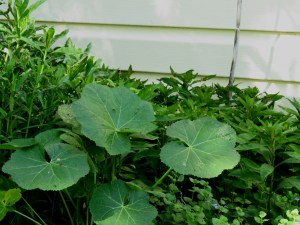
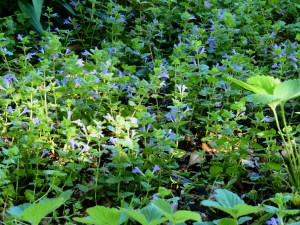
There’s also common speedwell – – not native to North America, it’s certainly made itself at home. Every spring, I think I’ll just give in and call it my ground cover. But, every spring, I tug and tug and tug it out, knowing my efforts are futile. It’s long runners will produce new shoots faster than I can say, “shoot.” I apply mulch like a pillow to a face and hope against hope it won’t resurface.
So, my gardening season begins in a sort of panic. Pre-Lyme, I was a butterfly – – fluttering from task to task; soaking it all up, productive and happy. But, I’ve become a caterpillar. I inch along, stay low to the ground, always seated. I pull the garden cart – – two steps then rest, two steps, then rest.
I am defeated before I start. It’s a simple fact.
I know gardens are never finished, even for the healthy. That used to make me happy, but now I’m more acutely aware that my growing season is limited and feel pressure to get it done; make it perfect. I want to make the most of what I have, but spring and summer outpace me. I can’t keep up anymore.
Gardens are places of constant change and perpetuation. They’re filled with decay, death, and disease, but they heal, even resurrect. A garden can be suffocated by alien life; its residents killed by ignorant gardeners who don’t bother to learn what their plants need.
But, they endure. They not only withstand fire and freezing but rise new and vibrant from the ash and snow.
Gardens keep trying.
I am also in a perpetual state of succumbing to disease and decay, then standing again in healing and new growth; succumbing, healing – – always starting over. There are days, when dry, brown, and brittle are all I know and days of flourishing, of feeling bright, full of color and hope.
But, this year’s different. After four years of treatment, and at the risk of being overrun, I decided to stop. I told my doctor I was taking some time off, that I didn’t want to spend the warm days as a patient, keeping appointments, and swallowing pills, or worse, those brown, acrimonious tinctures so popular among Lyme-killers. I have had the same symptoms for a long time, without change, so I need to think.
Can I live with some dry twigs? Develop a rapport with these invaders? Can we function as one?
Do I have to keep snapping off the brittle remains of my old self, making room for new shoots only to find them dead again? Must I continue plucking and pulling at invisible bacteria, viruses, parasites only to find them alive because their roots are many and strong? No amount of pruning or pesticide has destroyed my vermin. Can I just call them my cover? Pretend they belong?
Is it possible to simply look away?
I mean, they aren’t unobtrusive.
The fatigue crushes. Pushing a spade into the earth is not always possible. Somedays, I’m too weak and worn-out.
I bend to plant, then raise up gasping for air, heart pounding, hand to chest wondering if it’s a heart attack or just a Lyme-fake. Can I ignore this?
The depression is dark, an immovable mass; the anxiety like pieces of paper in a blender, swirling, coming close, but never hitting the blades. Some days in the garden, I spend in numb defeat, ruled by blight, sitting in slumped surrender. Other days, I cry, knowing it’s too much, and like me, will never be what it was. How do I keep planting hope when I’m buried? How do I take root and find peace, when I’m scattered?
The roaming, restless pain can’t find a place to land. It rears its head without warning, subsides without a hint. It aches, stabs, stings, burns, spasms, pounds, pierces, throbs. Sometimes, my insides are a bug zapper, overrun by bugs, constantly sending useless zings through my neurons; firing without apparent purpose and with miserable aim.
My brain is another world, where the barometric pressure is prone to dramatic shifts. It swells with damp clouds; blooms with a disorienting mist that steals words, thoughts, the ability to spell, converse, or feel things. Can I be fruitful in a stupor?
As I yank speedwell, and ponder what to do, a tiny green butterfly stops for a sip from one of the relentless weeds. I smile. My nemesis, is this little pollinator’s vast spread of sugary nectar. I’ve heard it before and have said it myself – – weeds have purpose. Struggle and suffering feed our character, nourish our souls, and point us to God. I could end this post on this inspirational note; could list the benefits of trials and the hidden blessings of chronic disease. In my writer’s brain, the butterfly is metaphor for mind and heart; for the way they discover sweetness in weeds. 
But, that rosy conclusion wouldn’t be an honest picture of how I feel, not right now. From my little stool, in my big garden, in front of me, I see a small circle, cleared of weeds, filled with multi-hued snapdragons. But if I look left, right, in front of, or behind those flowers, I see speedwell. I see gooseneck loosestrife. I see my perennials looking for air, for light, and finding little of either. I see small gain and huge loss. Clearing this circle was costly and painful, and it won’t last. The dragon slayers are waiting to move in.
This ring of frilly, radiant dragons represents a few good days and some small victories, but mostly, treating Lyme has been like pulling weeds with long, stubborn roots that worm through my body, finding and taking everything. Sometimes, it seems treatment only clears the way for a new batch as soon as the medicine stops.
A successful garden, free of weeds and pests, starts with healthy soil; invites good soldiers – – ladybugs, toads, spiders – – to stand at the ready and make quick work of those bugs that would do harm. It has just enough hours of sunlight to warm the ground without thieving all moisture. It catches the rain and draws it toward the roots; doesn’t hold it on the surface in pools and puddles that corrode.
My “soil,” my internal bed, isn’t healthy. I’ve been looking for green, digging in, doing the right things – – diet, exercise, sleep, meditation, prayer. Ideally, these actions should feed my defenders – – those good bacteria and antibodies. They should open a path for nutrients, supplements, and tinctures to reach the places where they can do their promised work.
But these things work until they don’t. Sometimes, they just don’t. And that’s the problem.
This disease keeps finding its springtime. It keeps starting over, forcing me to do the same. I just don’t know if I can keep it up, keep pulling internal weeds, when to the left and right and all around I see illness – – a snaking, complex, foreign system – – that has made itself at home and thrives at my expense.
This disease will never be finished. I know this, and I know that means my efforts to vanquish it will never be either. It’s one of the first things I learned about Lyme – – that remission and maintenance are the goals, not cure. But, I feel so weary thinking of a life spent clawing out small circles of open space, a life of choosing, over and over again, to try and get done what I cannot. That choice, repeated many times, is wearing me down.
Of course, I won’t give up my garden – – not yet. I’ll do the best I can and try to be content when my efforts to eliminate speedwell or all that strife fail. I’ll try not to look at them, but instead focus on the plants I choose – – the ones I’ll nurture. I’ll look at butterflies when they show up, if only for a moment.
But, my body . . . I don’t know. I am losing the drive to clear the way and clean the slate and am, perhaps, at a place of surrender to the reality of more weeds than snapdragons, more shade than sun, more gasping than breathing. I am understanding that I may have to dig a little deeper to find the green and that I may not be strong enough to do it.
Lyme Disease keeps trying.
Lyme feels like this.
Psalm 119:49-50 Remember your word to your servant, in which you have made me hope. This is my comfort in my affliction, that your promise gives me life.


 Lyme Feels Like This